
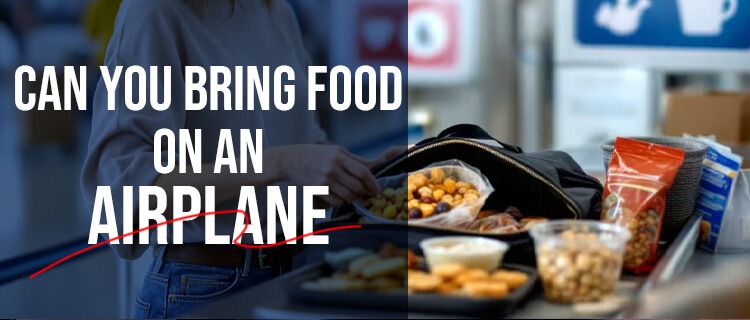
When you are at an airport, you see long lines, cramped areas, and crowds at security checkpoints. Another thing you may notice is the overpriced snacks at the airport.
At that point, you may wonder, “Can I bring my own food on a plane?” So, is it possible to bring your own food on the airplane? The answer is yes—you can bring food on a plane. However, there are a few rules and tips to keep in mind before packing your snacks.
The Transportation Security Administration (TSA) has guidelines on which food items are allowed through airport security and on board flights. Knowing these rules beforehand can save you from delays or additional screening at the airport security checkpoint. So let’s begin and learn more about it.
Can You Take Food Through Airport Security?
Yes, you can take food through airport security. However, for this, you should know which foods are allowed by the Transportation Security Administration. TSA allows most solid foods in your carry-on bag. This includes sandwiches, nuts, fruits, granola bars, and baked goods.
However, if you want to take liquid or semi-liquid food, such as yogurt or sauces, you have to follow the TSA’s 3-1-1 rule. The rules for liquid items are stricter. You may carry liquid or semi-liquid foods only if:
- Containers must not exceed 3.4 ounces (100 ml) each.
- The food container must fit in a one-quart-sized clear bag.
Can You Bring Food in Your Carry-on Bag?
Yes, you are allowed to take food with you on a plane. Bringing your own food is a good way to save money, especially at airports where food prices are often high.
If you are flying in economy class or on a budget airline, bringing your own food can save you money, as many budget airlines and short-haul economy flights do not offer complimentary meals.
TSA rules vary depending on the type of food or beverages you are carrying. For example, if you are taking solid frozen foods like meat, seafood, or vegetables, you can easily pack them in either your carry-on or checked luggage.
Can You Pack Food in Checked Baggage?
Yes, you can bring food in checked luggage. TSA restrictions are generally more relaxed for food packed in checked baggage. However, the rules here are a little different from those for packing snacks in your carry-on.
Generally, there is no limit on size. So if you want to bring larger quantities or foods that are not allowed in your carry-on, you can definitely put them in your checked luggage.
Solid Foods
The solid, non-perishable foods are the safest for checked luggage. TSA is generally more lenient with solid food items. These items are unlikely to become damaged or spoiled during your journey and are easy to pack around other items in your suitcase. You can easily bring quick snacks like crackers, cookies, granola bars, or even chips.
Still, you need to be a bit careful even with the solid food items. For instance, if you are thinking of bringing nuts, dried fruit, or packaged snacks, make sure to put them in airtight containers. This helps prevent spills or odor from escaping and keeps your luggage clean.
Liquids and Sauces
If you are carrying soups, sauces, gravy, or salad dressing in quantities larger than 3.4 ounces (100 ml), it is best to pack them in checked baggage. Packing these items in checked baggage helps you avoid the liquid size restrictions that apply to carry-on luggage.
What Foods Are Allowed on a Plane?
Here is a quick overview of the foods you can bring on a plane and those you should avoid:
Allowed Foods on a Plane:
According to the TSA, the solid and packaged foods that are allowed are as follows:
- Sandwiches and wraps
- Salads (without heavy dressing)
- Fresh fruits and vegetables
- Nuts and trail mix
- Chips and crackers
- Granola, chocolate, and protein bars
- Cookies and baked goods
Foods to Avoid Bringing on a Plane:
Some foods are best avoided in carry-on baggage because they may leak, spoil, or create strong odors during your journey. These include:
- Don’t bring liquid or gel items in carry-on baggage if they exceed 3.4 ounces (100 ml)
- Strong-smelling foods.
- Foods that require refrigeration unless packed properly.
Conclusion
Bringing your own food on a plane is an easy way to save money and enjoy your favorite snacks during your trip. Most solid foods are allowed in the carry-on or checked baggage, while liquids and semi-liquid foods must comply with TSA’s 3-1-1 rule when packed in carry-on luggage. So, before you travel, check the TSA guidelines and your airline’s policies to avoid delays at security and enjoy a hassle-free journey.